Backing the Book: Funding Your Loan Book With Debt, Not Equity
How a facility structured around your assets lets equity fund the business, not the loans.
Strip away the app and the branding, and most fintechs are lenders. A BNPL pays the merchant today and collects from the buyer in 30 days. A leasing business buys the laptops upfront, and gets paid back over two or three years. A solar finance platform advances the installer and waits for the customer to pay. Outside fintech, a robotics or hardware-as-a-service company pays for the kit upfront and earns it back through monthly subscription fees.
All of that needs funding, and equity is a very expensive way to do it – more on this in my earlier article, How to (and How Not to) Raise Venture Debt (and maybe even Equity…). Funding a 30-day invoice book with venture capital is a bit like paying for your weekly shop with a mortgage: it works, but you’ll regret the cost. Equity should pay for the team, the tech and the losses while you prove the model. The book itself should be funded with debt.
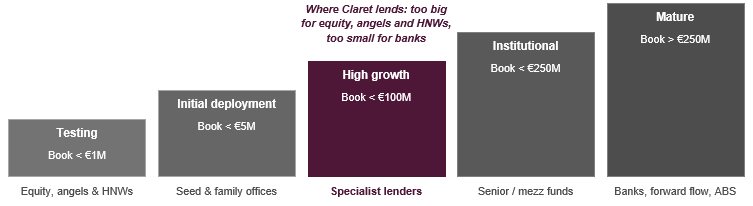
The problem is who provides that debt. Banks and large ABF funds want seasoned books above €250M, and with European fintech VC down 75% from its 2021 peak1, equity is harder to raise. A €5-100M book has few places to go. That is where Claret fits.
The short version
- Fund the book with debt, and keep your equity for the team, the tech and growth.
- We lend against your assets, not your valuation or your next round.
- The facility grows with the book: as you originate more eligible assets, you can draw more.
- We structure it with you: SPV or corporate facility, advance rates of up to 95% and reporting built around your data.
Who funds the book at each stage of growth
A Facility Built Around Your Book
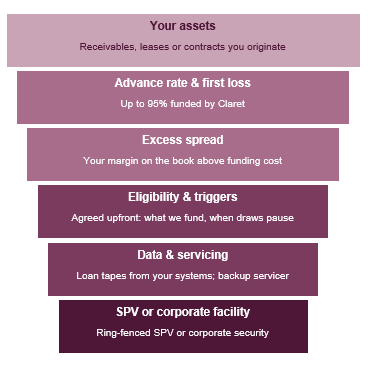
We lend against what you originate, not against your valuation. Your receivables, leases or contracts form a borrowing base, and the facility moves with it: as the book grows, so does what you can draw.
Claret provides stretch senior and mezzanine facilities with advance rates of up to 95% against eligible assets, depending on the asset class and the stage of the business. You fund the rest. Eligibility rules and triggers are agreed up front, so you know what we fund and when drawdowns pause before you scale.
Where the book sits in a bankruptcy-remote SPV, the facility rests on the assets. Earlier-stage businesses without one can still borrow against the book, with security at the corporate level. Either way, we build reporting around your existing data: daily or weekly loan-level tapes, not a new system.
How a Claret facility fits together
What We Finance
These are the kinds of venture-backed businesses that have come across our desk in the last 12 months. If your book looks like one of these, we should talk:
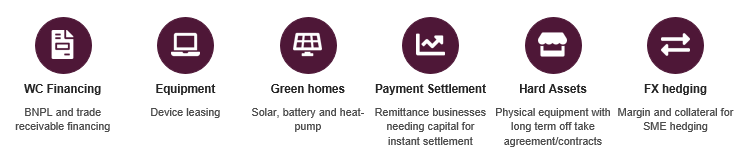
A good rule of thumb: if the asset pays itself back faster than the company could refinance a loan, it probably belongs in an asset-backed structure.
Why Work With Claret
Asset-backed facilities are hard to get right, and we know where founders get stuck. Claret has lent to European tech companies for more than a decade. Scaling a lending business takes a lender with the structuring know-how to grow with you.
- Too small for the big lenders. A €5-100M book sits below the minimum ticket for banks and large ABF funds. That is the size we lend at.
- Too complex to do alone. New asset types, loan-level data tapes, borrowing bases, triggers and legal work across several jurisdictions. We have done this before, so that work sits with us.
- Growing too fast to wait. You need certainty on what you can draw and when. We agree it up front, so funding keeps pace with the book.
If your book has outgrown funding from equity, angels & HNW, get in touch with George: [email protected]
Published by Claret Capital Partners Limited (authorised and regulated by the FCA, FRN 993228) for information only. Not an offer of financing or an invitation to invest, and not financial, legal or tax advice. Figures are unaudited and illustrative; third-party data is unverified; deal examples are anonymised.